

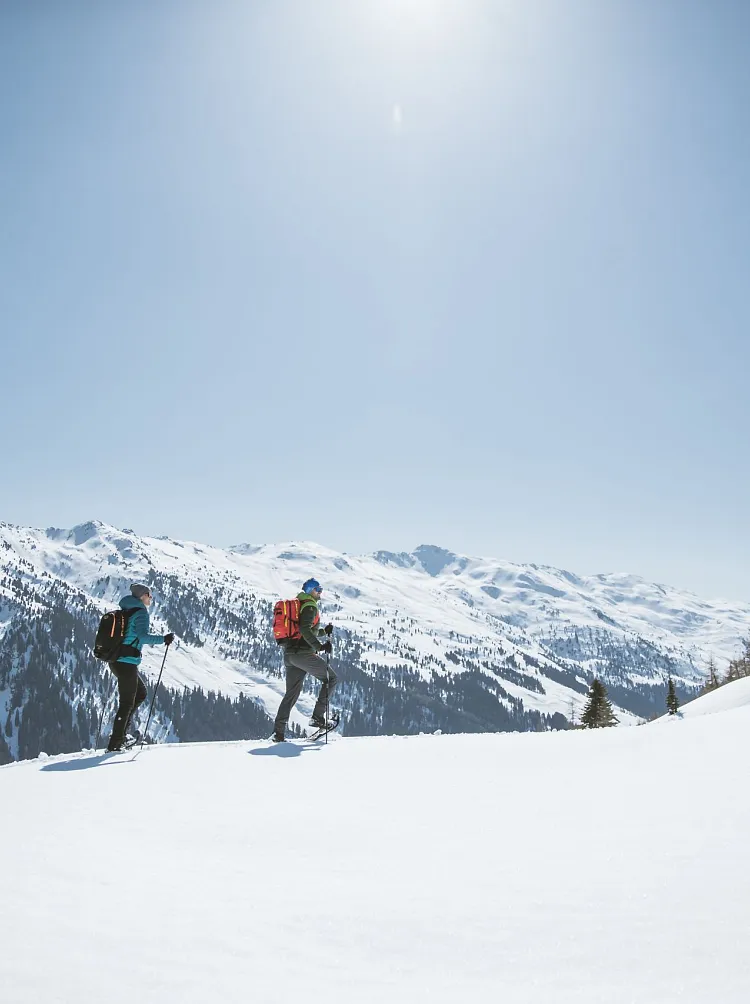

When snowshoeing in the Karwendel Silver Region, winter becomes utterly still: snow-covered forests, vast alpine pastures and views across the Inn Valley to the peaks of the Karwendel. Whether you set off on your own or join the snowshoe hiking weeks with others, every tour shows you the mountains at their most tranquil.

Winter
programme
The winter programme for the Karwendel Silver Region features guided snowshoe walks every week. Accompanied by a guide, you’ll head up to the sun-drenched plateaus and through snow-covered forests. This way, you can experience winter on snowshoes even without any prior experience.


Classification of snowshoe walks
How difficult is your route?
Very easy (WT1 – easy snowshoe hike) – less than 25°, generally flat or only slightly steep. No steep slopes in the immediate vicinity, no risk of avalanches and no risk of slipping or falling.
Easy (WT2 – snowshoe hike) – less than 25°, generally flat or only slightly steep, but with steep slopes in the immediate vicinity. There is a potential risk of avalanches, but no risk of slipping or falling. You need basic knowledge to assess the avalanche situation.
Medium (WT3 – challenging snowshoe hike) – less than 30°, generally slightly to moderately steep with short steep sections. There is a potential risk of avalanches; the risk of falling is low, and any slides are short and run out. You need basic knowledge to assess the avalanche situation.
Difficult (WT4 – snowshoe tour) – less than 30°, moderately steep with short steeper sections or traverses. The terrain is partly rocky and partly on glaciers with few crevasses. There is a potential risk of avalanches; the risk of falling is low, but there is a risk of injury. A good understanding of the avalanche situation, good walking technique and basic mountaineering skills are essential.
Very difficult (WT5 – alpine snowshoe tour) – less than 35°, with short steeper sections, traverses or rocky steps, including on glaciers. In addition to the risk of avalanches, there is a risk of falling and falling into crevasses, as well as other alpine hazards. A good understanding of the avalanche conditions, sound alpine skills and sure-footedness are essential.
Good to know: The classification applies in good snow and visibility conditions and does not take the length of the tour into account. Check the avalanche report before every tour.
You can find all further information on the classification here
Rules of conduct for snowshoeing
Respect for nature
Snowshoes allow you to explore tranquil winter landscapes, which serve as vital refuges for many wild animals. A few rules will help ensure that this remains the case.
Respect protected areas. Stick to designated wildlife quiet zones and do not enter reforestation areas. Where possible, only cross woodland areas on authorised paths and routes.
Observe wildlife from a distance. Give way to animals if you see them, and retreat quietly. Avoid feeding stations. Every time they have to flee, it costs the animals a lot of energy in winter.
Be mindful of the time of day. Do not venture out into the countryside before sunrise or after sunset.
Keep dogs on a lead. This is particularly important in winter to avoid startling wildlife.
Keep cross-country ski trails and slopes clear. Snowshoes leave deep tracks. Do not walk on cross-country ski trails or ski slopes, and only cross them if necessary.
Do not leave any rubbish behind. Take everything you brought with you back with you.
Travel in small groups. This keeps things quieter and minimises disturbance to nature.
You can find all the rules of conduct here
Tour planning & equipment
A good snowshoe hike starts with planning the night before. With the right preparation, you’ll be safe on the trail and can enjoy the peace and quiet of the snow.
Choose the right route. Select a route that suits your fitness level and experience. You’ll make slower progress in deep snow than when hiking in summer.
Check the weather and avalanche conditions. Before setting off, check the weather forecast and the Avalanche Report. The days are short in winter, so set off early enough.
Stick to the marked routes. This way you’ll stay safe, and the wildlife will be left in peace during winter.
Set off well equipped. Essential items include snowshoes with climbing aids, poles with snow baskets, waterproof winter boots and warm clothing layered according to the ‘onion principle’. Your rucksack should contain a warm drink, a snack, a first-aid kit, sunglasses and a fully charged mobile phone.
Off the beaten track. In open terrain, you’ll need avalanche equipment (avalanche transceiver, probe, shovel) and the knowledge of how to use it. It’s easier to join a guided tour.
In an emergency. Alpine emergency number 140 or European emergency number 112.
Staying safe on the go: Click here for the emergency app.
All tips for planning winter tours
